
The stock market’s price to earnings ratio is a decent way to gauge how cheap or expensive stocks are. It tells us the price investors are willing to pay for each dollar of profits the businesses behind those stocks make.
The other way to look at that ratio is by flipping it around. That is, earnings divided by price which gives us the earnings yield.
The PE ratio keeps moving around everyday as stock prices change. The earnings yield hence changes with it.
But stocks must give you a higher yield than a similar duration safe investment or else why would you invest in stocks.
Duration tells us about optimal holding timeframes for investments. An investment with a duration of 10 years means you should ideally hold that investment for a minimum of 10 years to make it worth it.
Stocks are ownership stakes in businesses. Their values are based upon the profits those businesses make in the long run. That long run is a minimum of 10 years and ideally more.
But profits don’t grow in a straight line. They are volatile. Stock prices hence are volatile by design. That volatility smoothens out as holding periods extend.
Also, markets are made of human beings and human beings are neurotic. At times they are too optimistic and will bid up prices sky high and at other times, they become despondent and will give stocks away. Volatility during those times can be extreme.
What lies at the other end of the spectrum to owning stocks? Something that is not volatile, something that feels safe, warm and fuzzy with built in guarantees. That comparable other end is the 10-year Treasury bond.
And because of the inherent risks with owning stocks, you’d demand a higher yield from them over the yield that a 10-year Treasury bond pays. That difference in yield is the equity risk premium. If you want to sound fancy, you call it ERP.
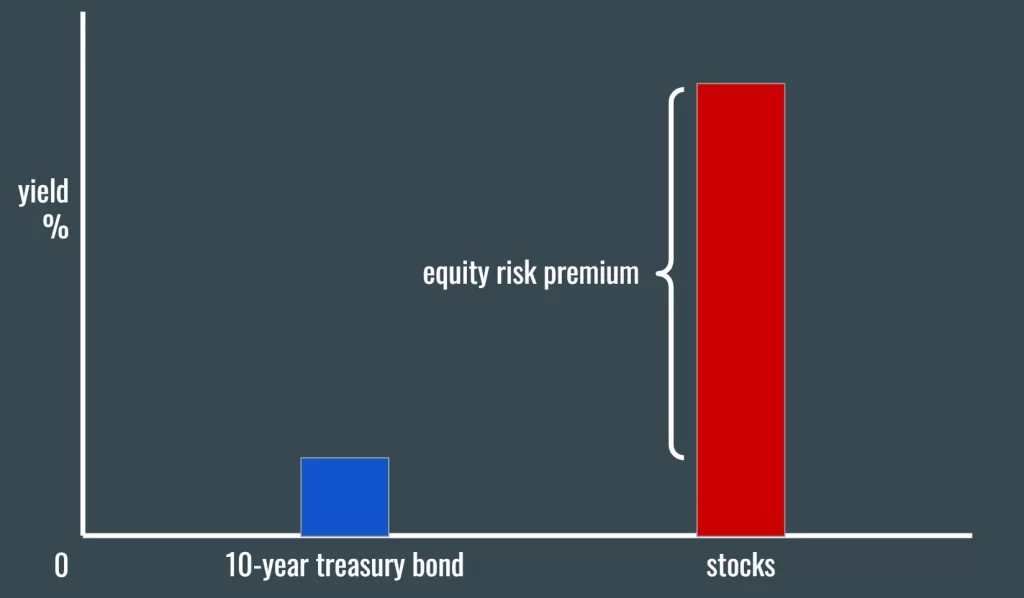
So when you invest in stocks, you’d compare what you expect to make owing them against what the 10-year Treasury bond pays. Wider yield differences signal bad economic times but they are usually the best times to invest in stocks.
And when everyone is fat and happy, stupidly making money is when the yield differentials are the narrowest and are the worst time to invest in stocks.
And everything is tied to that 10-year Treasury bond yield. It is a baseline that guides all savings and investment decisions – in your home, in your business and across the economy.
Keep that yield in sight.
Thank you for your time.
Cover image credit – Jinto Mathew, Pexels