
Doveryai, no proveryai is a Russian proverb whose English translation trust, but verify was made famous by President Ronald Reagan when negotiating nuclear disarmament with his Soviet counterparts. But using it in everyday life requires the right context which Nan S. Russell in Psychology Today highlights…
When outcome is essential and matters more than relationship, use trust, but verify. When relationship matters more than any single outcome, don’t use it.
But since we are talking here about being good stewards of our money, we trust little and verify a lot. And that task gets easier with access to data.
We have all heard about portfolio rebalancing and it means exactly as it sounds. So say we start with a portfolio with 60% allocated to stocks and 40% to bonds. With time, say the stocks/bonds allocation drifts to 65/35. If the intent is to maintain a constant allocation, we’d sell the stock component of the portfolio by taking out the excess and buy into the bond portion to bring the allocation back to 60/40. That is portfolio rebalancing.
And it sounds like a great idea. We sell something that has appreciated in value and buy into something that has not – a classic buy low, sell high setup. But Vanguard founder John Bogle did not believe in rebalancing and some of the reasons cited are that doing it entails taxes and transaction costs.
But taxes can be managed around when rebalancing is done right and transaction costs are not as big of a deal these days.
But is there any other reason besides these as to why Bogle did not believe in rebalancing? Like do we end up with less wealth to spend in retirement if we rebalance versus not? The only way to find out is by crunching our own numbers and that is what we’ll do.
We start with using historical returns data for four different asset classes to test the rebalancing strategy.
- Large-cap U.S. stocks
- Small-cap U.S. stocks
- International stocks
- U.S. bonds
We invest $100 in a portfolio composed of a mix of these at the start of the time period in varying proportions of 10% increments and assess whether rebalancing does what it is supposed to do. A snapshot of different portfolio compositions is shown below.
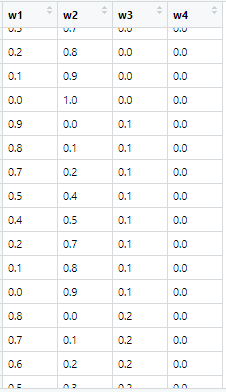
Each row is one portfolio and with 10% incremental allocation spread across four investment categories means we get 258 different portfolio combinations we get to try this on.
We start year 1 with the proportions specified and in year 2 in the rebalancing case, we sell whatever has moved up in proportion from the original allocation and buy what has declined to bring the allocation back in line.
For the invest & forget approach, we split and invest the original $100 into the allocation we started out with and let the money ride with no changes till the end of the period. The dataset we are using contains 49 years of data starting in 1970. We’ll compare the ending values of each portfolio to test the rebalancing vs. invest & forget approach.
The first thing we do is to get a feel of how the ending values are distributed between the two approaches.
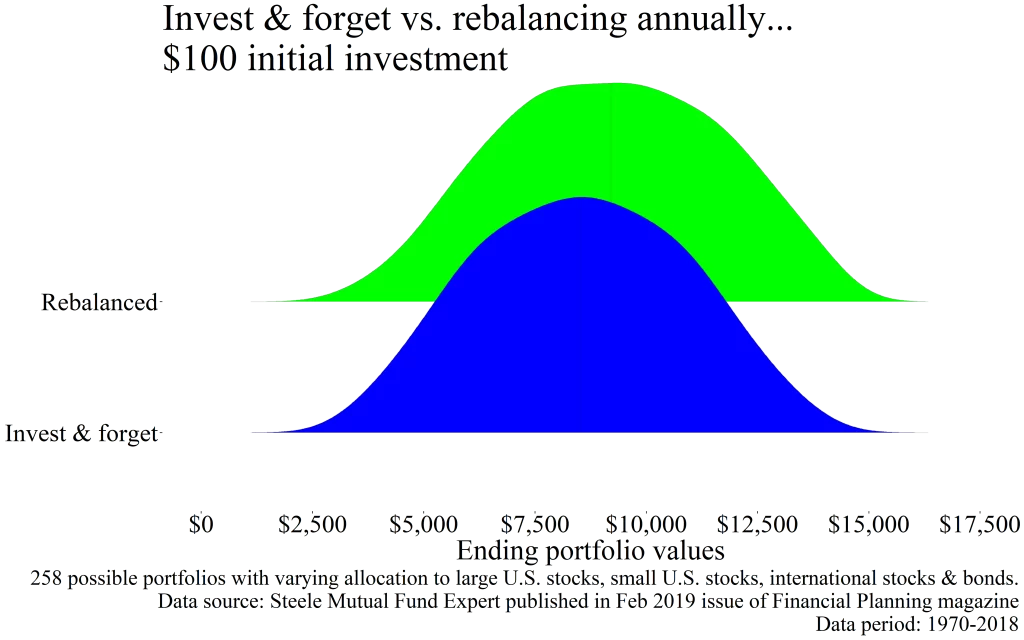
Rebalancing appears to be a clear winner as is evident from a slight right shift of its distribution as compared to that of invest & forget one. But are we comparing the same portfolios when comparing outcomes between the two? What we should ideally compare is the ending value of portfolio 1 in the invest & forget case with the ending value of portfolio 1 in the rebalanced case, the ending value of portfolio 2 in the invest & forget case with the ending value of portfolio 2 in the rebalanced case and so on.
So we do just that and this is what we find when doing portfolio by portfolio comparison of the ending values…
- Out of 258 possible portfolios, each with a different asset allocation, the ending values of 243 portfolios that were annually rebalanced equaled or outperformed those of the invest & forget ones. That is a 94% outperformance rate for the portfolios that were rebalanced versus not.
- 79 portfolios out of 258 total that were annually rebalanced outperformed invest & forget ones by more than 10%.
- And the ending values of three out of 258 portfolios that were rebalanced outperformed invest & forget ones by more than 25%.
So a strong vote in favor of rebalancing.
But what if we keep the bond allocation constant at say 40% as what most balanced funds do? Because maybe rebalancing is more effective between categories of investments (stocks vs. bonds) versus within categories (within stocks or within bonds).
So testing that out…
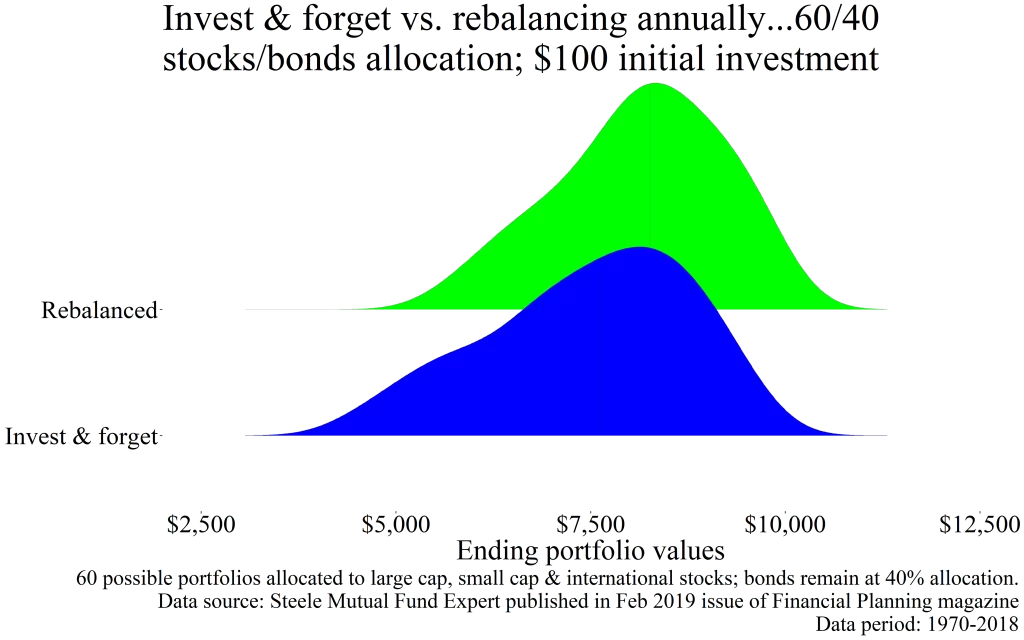
We see a similar right-shift in distribution in favor of the rebalancing strategy. And because the bond allocation was held constant with just the stocks category allowed to vary, only 60 portfolio combinations are possible.
A portfolio by portfolio comparison of the ending values yields the following results…
- Out of 60 possible portfolios, each with a different asset allocation and a fixed bond allocation, the ending values of 59 portfolios that were annually rebalanced equaled or outperformed those of the invest & forget ones. A 98% hit rate makes the case even stronger in favor of rebalancing.
- 25 portfolios out of 60 that were rebalanced outperformed invest & forget ones by more than 10%.
- And one outperformed invest & forget by more than 25%.
Rebalancing still wins.
What if we owned an all-stocks portfolio? Would rebalancing still outperform invest & forget?
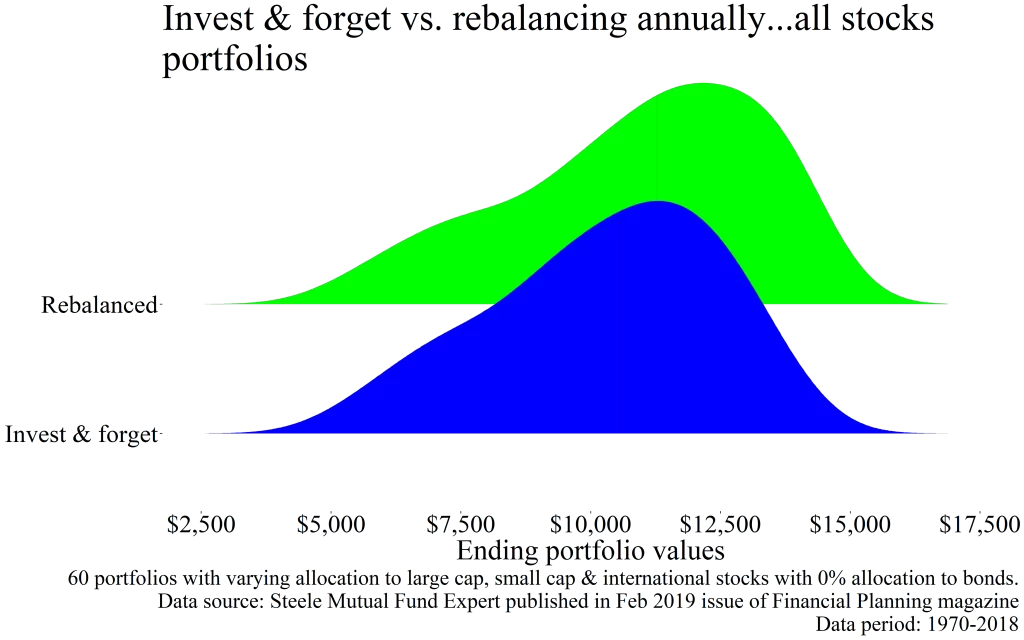
Appears to be a yes. And again as before, only 60 portfolio combinations are possible and a portfolio by portfolio comparison yields the following results…
- Out of 60 possible all-stock portfolios, the ending values with the rebalanced approach equaled or outperformed invest & forget each and every time. So a 100% hit rate in favor of rebalancing.
- But none of them outperformed by more than 10% so not a big thumping vote for one over the other.
But what if the returns of the past do not repeat in the same sequence? Could the outcomes be different with a different sequence of returns? Good question.
To answer that, we’ll now randomly sample returns for each asset class and recreate a new annual returns dataset each time and we’ll do that for 500 times and compare the ending portfolio values between the two approaches each time.
We start first with portfolios built out of a combination of all four investment categories…
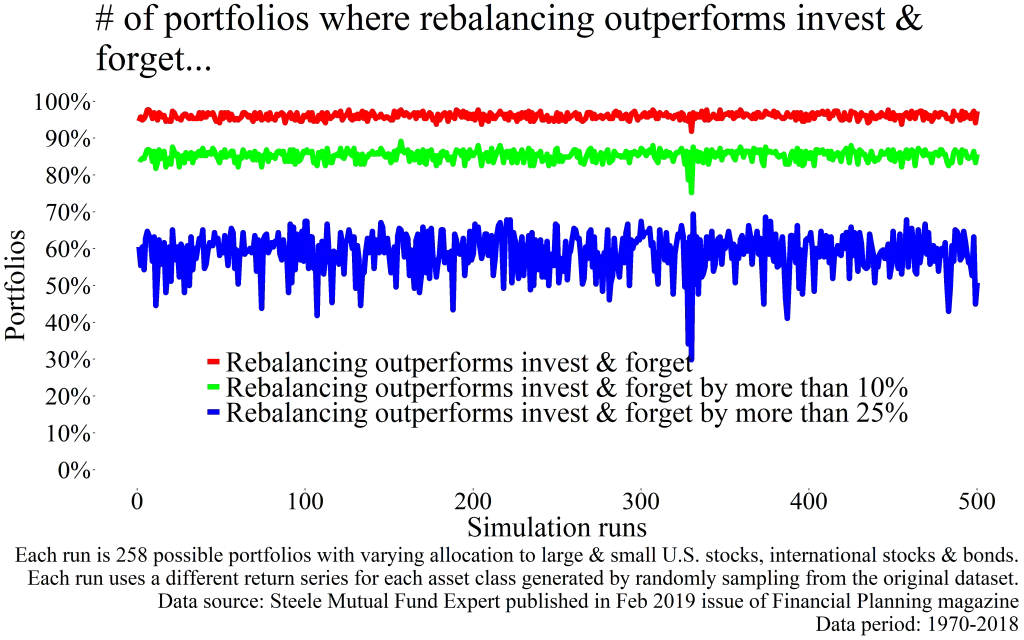
Each simulation run is 258 possible portfolios of the four investment categories we used. We are comparing the ending values for each portfolio between the two approaches and recording what percent of those portfolios that were rebalanced outperformed the ones that were not. That is one data point. And we repeat that process 500 times.
The red curve above shows that more than 90% of the portfolios that were rebalanced outperformed static allocation. The green curve shows the percent of portfolios that were annually rebalanced outperforming a static allocation by more than 10% in each simulation run. The blue curve shows the number of portfolios that were annually rebalanced outperforming static buy-and-hold approach with each simulation run by more than 25%.
So a strong vote in favor of rebalancing even when randomizing the historical asset class returns data.
What about with the classic 60/40 stocks/bonds balanced portfolios?
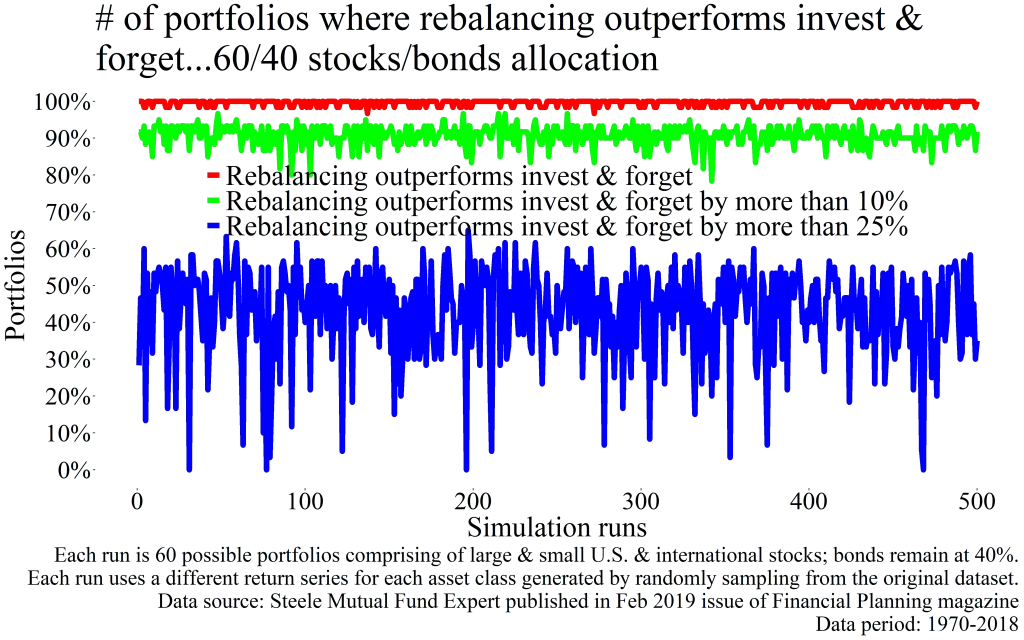
Same story. Rebalancing works almost all the time.
We’ll try the same for an all-stocks portfolio with just three investment categories: large cap U.S. stocks, small cap U.S. stocks and international stocks and the streak of the rebalancing approach outperforming a static buy-and-hold approach continues.
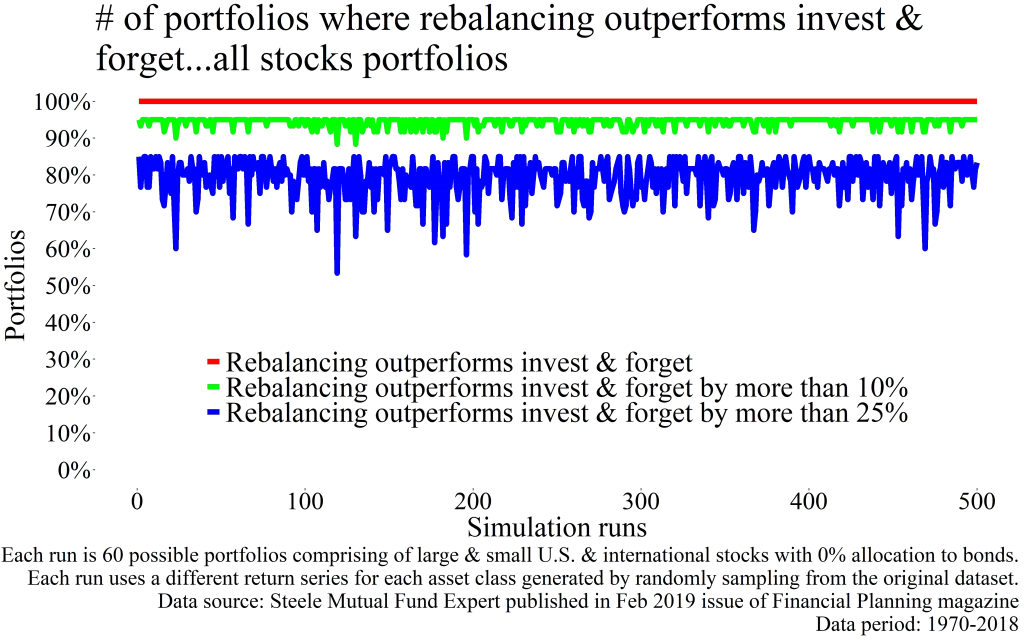
So you’d be crazy to not rebalance your portfolios from time to time.
But here’s a thing. This whole premise is based on the fact that mean reversion will always happen. That is, if an investment has deviated from its normal course either on the upside or on the downside, it will eventually revert back to its mean course over the long term.
But what is long term? Ten years, twenty-five years, hundred years? We can only know this in hindsight and maybe long after we are dead so that is one thing to consider.
And what if an investment ceases to exist? Individual companies we know live and die all the time so to guard against that risk, we diversify into a sector. Could an entire sector vanish or never, ever revert back to its mean trajectory of growth? Yes, it can.
What about countries? That is easy, Japan.
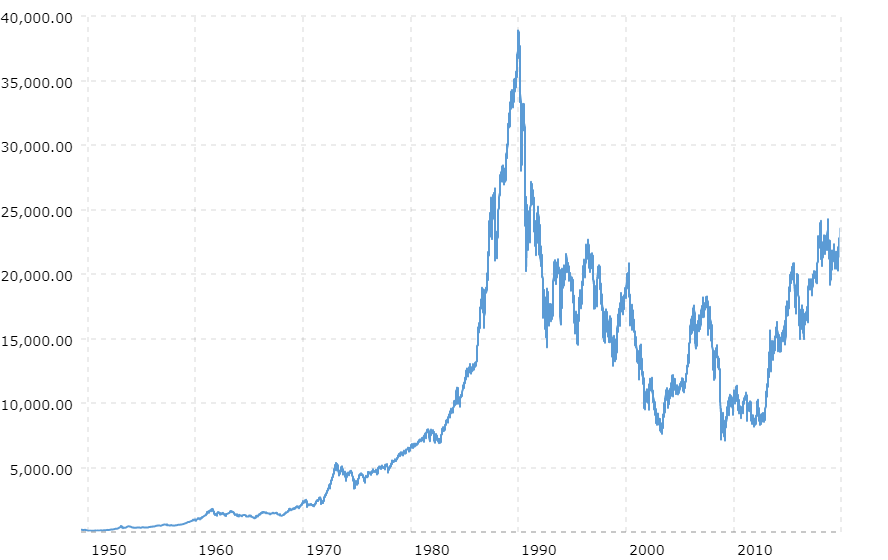
The post-war rebuilding which culminated into a real estate led economic boom of the 1980’s Japan was so big and went on for so long and the fact that it all came crashing down does not do enough justice to the sheer scale of that bubble. Edward Chancellor in his book, Devil Take The Hindmost chronicles the reasons for the boom and what led to its eventual implosion.
Between 1956 and 1986, land prices increased 5,000 percent, while consumer prices merely doubled. During this period, in only one year (1974) did land prices decline. Acting on the belief that land prices would never fall again, Japanese banks provided loans against the collateral of land rather than cash flows.
So the banks lent money because the value of the land rose. And the more it rose, the more they lent, creating a self-fulfilling feedback loop of ever rising prices, leveraged to the hilt. Things got so crazy that by 1989…
The grounds of the Imperial Palace in Tokyo were estimated to be worth more than the entire real estate value of California (or Canada, if you preferred).
The post-crash recovery didn’t quite materialize or hasn’t yet materialized and it could take a long while. So if you were counting on that reversion to the mean for Japanese stocks, that may not happen in your lifetime.
So we need to put a lot of thought into what we include in our portfolios if we are building a 50-year plan which most of us need. That is because entire categories of investment may never recover in this winner take all economy.
And even with all this evidence, I am not completely sold on the rebalancing approach especially within categories of investments like within stocks or within bonds because that reversion to the mean may not ever happen. Rebalancing between categories (the stocks/bonds allocation) may be needed for risk reduction purposes though but even that depends on the size of your portfolio and how much market heat can you withstand.
So I employ a mix of both strategies because I don’t know the future. No one does but try we must with a bit of intuition and a lot of supporting data and evidence.
Thank you for your time.
Cover image credit – Chevanon, Pexels