
At a county fair in 1906, statistician Francis Galton observed a “guess the weight of an ox” competition, where participants tried to estimate the animal’s weight. After analyzing nearly 800 guesses, Galton discovered that the crowd’s average estimate was remarkably close to the ox’s actual weight. In fact, the collective guess was more accurate than most individual guesses, including those made by experienced cattle experts.
On May 27, 1968, the USS Scorpion, a 3,500-ton nuclear-powered attack submarine carrying 99 men, disappeared beneath the Atlantic Ocean. At the time, no one knew exactly where the submarine had gone down, and experts’ estimates of its location were scattered across thousands of square miles of seabed. Remarkably, when those estimates were combined, the collective judgment pinpointed the submarine’s location to within about 220 yards.
This is the essence of the wisdom of crowds. The average judgement almost always converges on the right solution. One of the most compelling demonstrations of the wisdom of crowds at work can be found in the stock market’s reaction to the Space Shuttle Challenger disaster. What happened in the market on the day of the tragedy—and in the aftermath—offers a striking example of how a crowd can uncover the truth before all the facts are known.
This is how the events unfolded…
On January 28, 1986, at 11:38am, Space Shuttle Challenger took off from its launchpad at Cape Canaveral. Seventy-three seconds into its flight, it broke apart killing all seven astronauts aboard.
Speculations abounded as to what caused the shuttle to disintegrate mid-flight with some claiming falling ice from the cold launchpad damaging the orbiter or a fuel tank leak that caused the explosion. To investigate that disaster, President Reagan established a commission that included the likes of former astronaut Neil Armstrong and physicist Richard Feynman.
But by 11.52am on the day of the disaster, literally within minutes, investors started dumping stocks of the four major suppliers to the Challenger program…
- Rockwell International that built the shuttle and its main engines.
- Lockheed that managed ground support.
- Martin Marietta that manufactured the ship’s external fuel tank.
- and Morton Thiokol, which built the solid-fuel booster rocket.
But one stock stood out and that was of Morton Thiokol. So many investors were trying to sell its stock that a trading halt was called almost immediately. By the time the stock market closed on that day, Morton Thiokol’s stock price was the hardest hit.
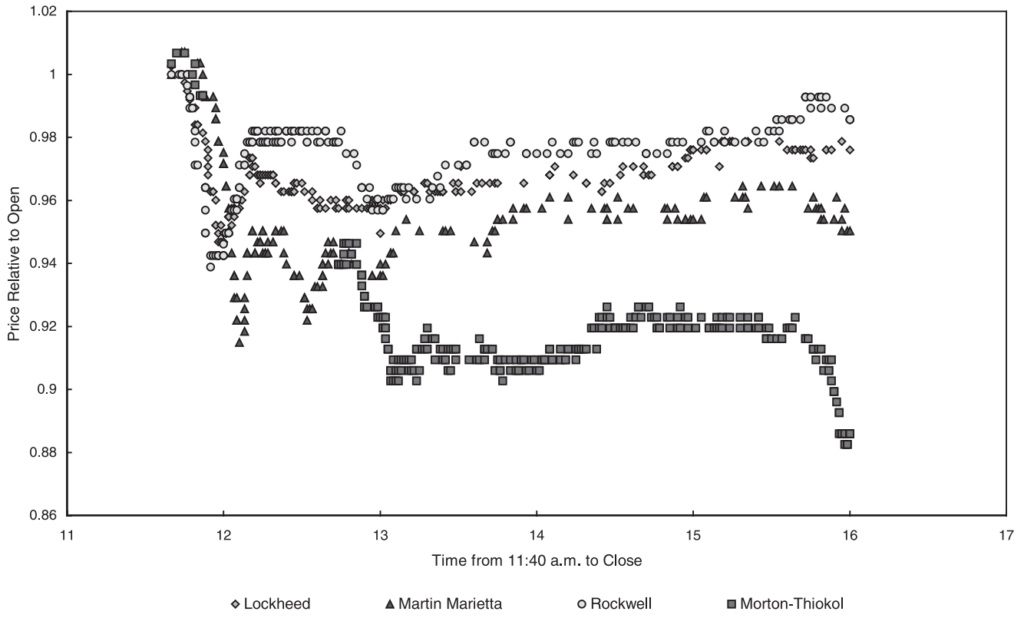
market: the stock market reaction to the
Challenger crash“, Michael T. Maloney & J. Harold Mulherin, Journal of Corporate Finance, 2003
On June 6, 1986, more than five months later, the commission concluded that the explosion was caused by the failure of the Shuttle’s now infamous O-rings that were part of the fuel booster rocket. Who made those O-rings? Morton Thiokol of course.
The stock market knew within minutes what took a commission of experts five months to figure out. This is how efficient the stock market is at processing new information and incorporating it into prices. And this occurred long before computers and the internet became commonplace.
And it may not be apparent but the price of a stock you see on your phone screens is not some arbitrary price. Enormous amounts of information is collected, collated and analyzed behind the scenes by millions of market participants to arrive at that price. Thinking you can consistently outsmart the market’s collective wisdom, no matter how skilled you believe you are, is a fool’s game.
But efficient markets do not mean that prices are always right and that all market participants are rational in arriving at their version of the right price. Prices are in fact always wrong. How could they be right? Prices are supposed to reflect the present value of all future earnings and future earnings can only be estimated with an enormous amount of error. The reality is that no one—not you, not me, not Goldman Sachs, and not even Warren Buffett—can know with certainty whether a quoted price reflects a stock’s true value. Yet, over the long run, you’re far more likely to profit by assuming that the market price is broadly correct than by assuming you know better than the market.
There is this joke among financial economists about a professor and student strolling across a university campus. The student finds a ten-dollar bill on the ground so he stoops down to pick it up. The professor stops him saying that if that were truly a ten-dollar bill, someone would have picked it up already. The market behaves the same way. If there is news about the economy or about a company, that information gets reflected into its price immediately.
So say there is a drug company whose stock trades at $20 a share. It then announces a successful phase 3 trial for a promising cancer cure and because of all the future profits the company is expected to make, the market now thinks it is worth $40 a share. The market will not wait around for the price to slowly converge to its estimated value of $40 a share. It will change to the new price in an instant. Because the market knows that the stock’s new value is $40 a share and anyone buying it below that price will make a profit. No one of course knows if the FDA will approve the drug or how successful the drug will be in the market or if any side effects that’ll pop up later or if there will be a competing drug in the future. But in that very moment, the market has collectively converged on $40 a share as the stock’s true value.
There are two ways you could have made money buying that stock…
- You bought the stock before the announcement of the successful phase 3 trial and once the results are announced and the market reprice the shares higher, you sell and make a profit. You gambled and you won because the phase 3 trial could just as well have failed. And then you’d see the stock price get cut in half or worse as it happens many times when companies announce bad news.
- You buy the stock after the announcement at $40 a share but the drug ends up becoming a blockbuster drug, making far more money over the ensuing years than what the markets had priced in. As the company reports more and more good news with all the profits they are making off that drug, the market is having to keep repricing the shares higher and higher from what it originally estimated.
In both cases, you got lucky (or unlucky depending upon the outcome). That is to say that there are no risk-adjusted excess profits that the market gives you. You took a chance and you won.
The wisdom of crowds though is not always right because the baseline requirement for a good crowd judgement is that people’s decisions are independent of one another. If the crowd gets influenced by each other’s guesses, there is a good chance that the guesses will drift away from the right answer.
This is what happens when we have asset price bubbles. But nobody can tell if we are in a bubble or how long it will last and when it will pop.
Let’s take the internet bubble for example. As Federal Reserve Chairman, Alan Greenspan warned of “irrational exuberance in financial markets” aka we are in the midst of a stock market bubble in a December 1996 speech, a good 3 years before the bubble eventually popped. But in the interim, the Nasdaq, where the bubble stocks primarily resided, went on to quadruple before the market realized its folly.
A few takeaways hence…
- For most investors, the key lesson from a wealth-building perspective is to act as though markets are efficient, even if they aren’t. If you’re investing for the long term, the goal is to avoid outsmarting yourself by making unnecessary bets against the market. Develop a long-term plan and stick with it while ignoring the interim booms and busts.
- At the same time, it is important to balance two seemingly opposing beliefs when building out your plan: prices are generally right, but sometimes people go crazy. During market bubbles, investors can become so optimistic that no price seems too high. At the depths of a market crash, fear can take over and make even the lowest prices seem too high. Successful long-term investing requires recognizing both realities. The good news is that market bubbles and crashes are rarely universal—they don’t affect every stock or asset in the same way. Holding a diversified mix of investments can therefore help protect your portfolio from severe declines in any single area.
- And last. you’d want to also consider where you are in this lifecycle of investing. If you are nearing retirement and don’t have substantial financial resources, it may make sense to adjust your portfolio to reduce exposure to near-term market losses. The goal is to strike a balance: be conservative enough to protect against severe downturns and avoid running out of money, while remaining invested enough to preserve your savings’ purchasing power as prices rise due to inflation.
In summary, respect market prices, but don’t let short-term market movements influence your long-term investment strategy.
Thank you for your time.
Cover image credit – Wendy Wei, Pexels