
This thing needs a constant reminder so before it gets too late, you need to read this. Because the push is strong and it will remain strong as there is so much money in it…not for you, of course.
There is only one kind of life insurance — the type where you buy say a million dollars worth of coverage, you die and the insurance company shows up with a check for a million dollars. So from the benefits perspective, all life insurance is the same. The only difference is how you pay for it and for how long.
For example, take a 30-year old, a 60-year old and a 90-year old who are all in the market to buy a million dollars worth of life insurance coverage. And we know that the 30-year old is the least likely to die in the coming year and hence will pay a lot less for the same coverage than the 60-year old who’ll get to pay much lower premiums than the 90-year old. This is straight out actuarial math.
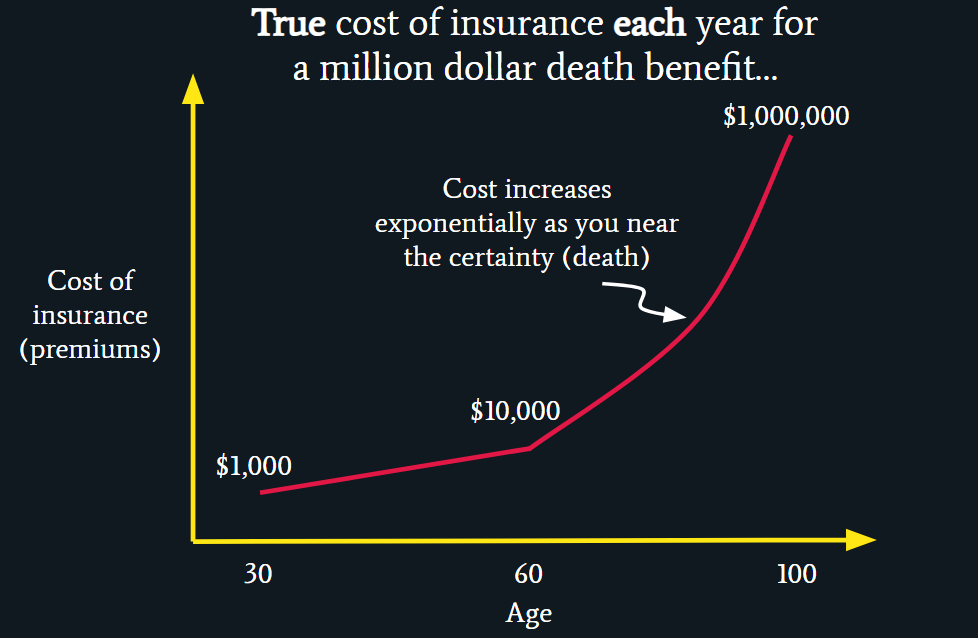
No one in their right mind hence would want life insurance for the entirety of their lives because…
- It does not make sense and,
- It will cost too much money.
You mostly need insurance between the ages of 30 and 60 when your family is young and is heavily reliant on your human capital. By age 60, your kids are on their own and you have spent your career honing your craft and in that process, exchanged a good chunk of your human capital for financial capital. A fixed-term life insurance that protects your human capital between the ages of 30 and 60 is the only kind you need. But that is not what is sold.
What is sold are policies that fall under the permanent life insurance umbrella where you pay premiums (cost of insurance) for life. Think about how absurd that sounds. You are insuring against the certainty of death and insurance companies will not be the one paying for it. You will.
The first kind of permanent insurance is whole life insurance where premiums stay the same for life.
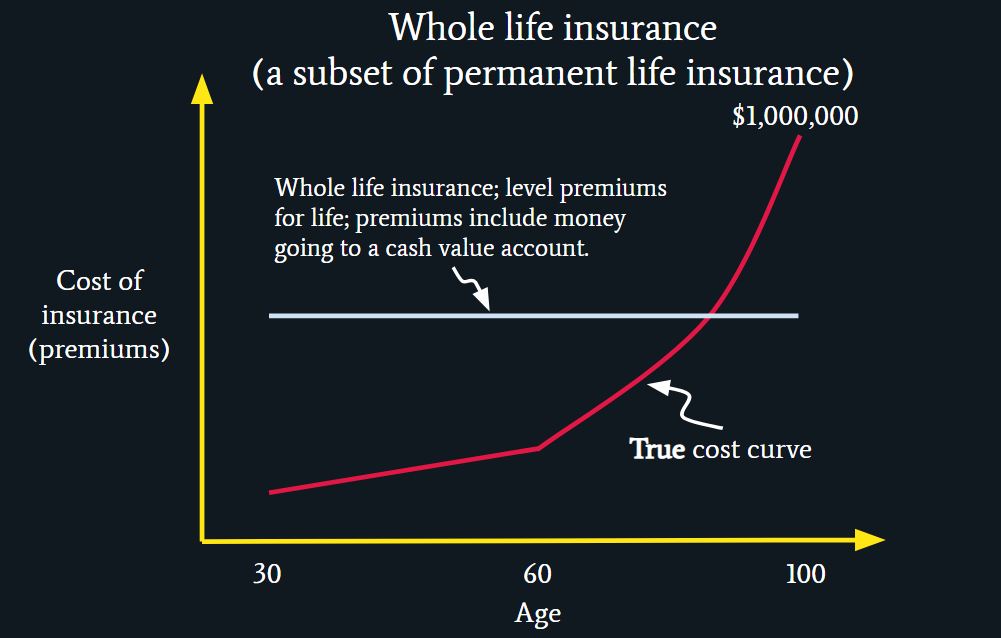
And because you are insuring your whole life, it costs more, much, much more than if you had bought an equivalent value term life policy for the amount of years you need coverage for. Part of the premiums with whole life is invested in a cash value account to pay for mortality costs later in life. This cash value is not your money. It belongs to the insurance company to pay for the cost of insurance in the later years of your life.
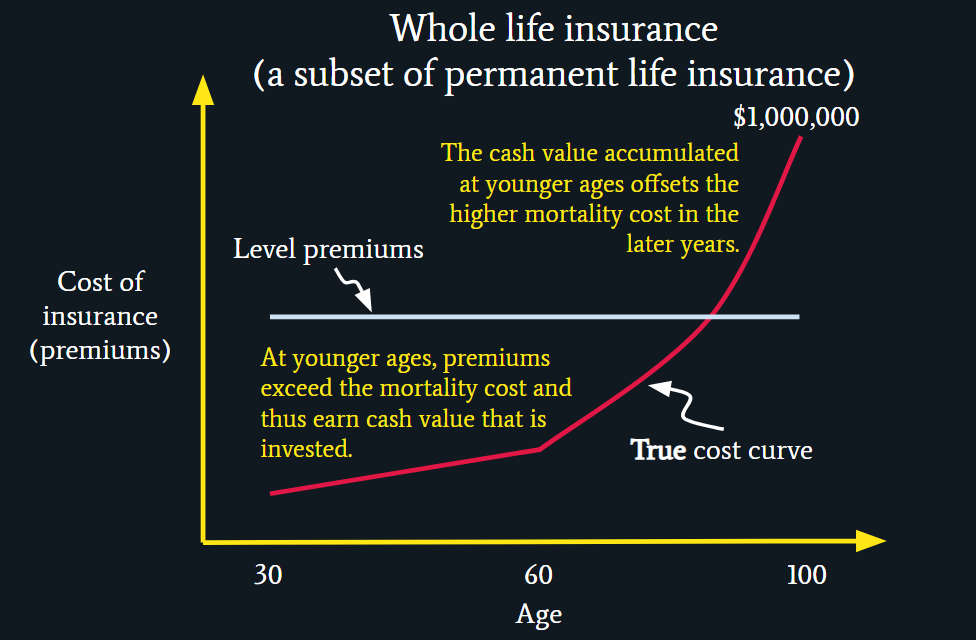
But this cash value component is what is heavily marketed as a supposed savings account with a fixed rate of return which you can then borrow against in a tax-free manner. But life insurance proceeds upon death are already tax-free so is it a shocker that you get to borrow the proceeds tax-free earlier than the eventual death. It is not.
And then the fees. Forget about any cash value of any kind for the first 10 years of owning these policies. If you abandon the policy in the first decade of owning it, you don’t get nothing. All is gone as fees to the agent who sold you that policy and to the insurance company to have brought this product to the market.
The second kind of permanent life insurance is universal life that comes with flexible premium payments along with an option to invest the cash value in the stock and the bond markets. The cash value hence fluctuates and can likely grow at a rate faster than the cash value in the whole life version. Lifetime premiums with universal life hence are oftentimes lower than for a similar value whole life policy.
But again, except for term life, choosing any other kind of life insurance is like trying to solve a problem that does not need solving. The industry brochure with their projections can say anything they want but these products will send you to the poorhouse with all the gigantic fees they’ll extract out of you in the interim.
And the pitch to sell them will sound so good as if they are the best things since sliced bread. Like they’ll say things like…
- You are throwing money away buying a term life policy as you get nothing in return if you don’t die. Well, you are not supposed to get anything while you got to protect your family in the interim at bargain prices.
- You get to withdraw “tax-free” income in retirement. You paid premiums with after-tax dollars so why is it a benefit when the insurance company will now allow you to withdraw those premiums tax-free? Had those premiums been invested in the stock and bond markets, you would have far more money than inside of a life insurance policy.
- You can take loans against your policy. Seriously? Should you be excited that you get to borrow your own money at high interest rates 30 years from now? I have seen whole life policies with quoted rates of 10% for loans. Imagine paying that kind of a rate to borrow your own money.
- The policy would eventually be “paid-up”. Congratulations, you’ve paid 100s of thousands of dollars in premiums for decades and now the dividends from your cash value covers the relatively cheap cost of the death benefit. The cost of the death benefit in the later years is still enormous but you have paid so much premiums over the life of owning that policy that even that enormous cost feels like a deal.
- You get tax-deferred growth of your cash value. You want tax deferred growth? Maximize your IRAs, 401ks and HSAs. And that cash value is not yours to keep. It pays for the cost to insure the entirety of your life.
A life insurance policy hence is not better than investing in a 401(k) or an IRA or a brokerage account. As a matter of fact, it should not be even compared to any of these accounts. Buying insurance is not investing. Insurance is bought to protect against catastrophic losses.
And just like you don’t expect to make money insuring your car or your health or your home, you should not expect to make money insuring your life. Anyone convincing you otherwise doesn’t have good things planned for you.
Thank you for your time.
Cover image credit – Nicola Barts, Pexels