
Johnny Depp was once the highest paid actor in the world with a net worth topping $650 million1. In 2017, he filed a lawsuit against his business managers accusing them of stealing all his wealth and leaving him penniless.
His managers countersued claiming that Depp spent $2 million a month maintaining his lavish lifestyle that included spending $500,000 on rental warehouses, $200,000 on private jets and $30,000 a month on wine2.
This is an extreme case but there are countless everyday stories like his where no amount of money seems enough when the expense side of the equation remains out of whack.
So back to you, say a yearly income of $50,000 plus income from Social Security takes care of all your expenses in retirement. And unless you are Johnny Depping your lifestyle, a $50,000 portfolio income plus income from Social Security is a lot of money to spend considering all your major expenses like housing and college costs are done by then.
To generate that $50,000 annual income, say you have $2.5 million saved up in a mix of retirement and brokerage accounts. Should you own anything but stocks?
Standard portfolio advice says that as you get closer to retirement, you should own less stocks and more bonds because if you had to sell stocks during bad times to generate the necessary income, you may not have enough stocks left when their prices eventually recover. That is why target date funds by default reduce allocation to stocks as you near the target year of your retirement.
A 4% safe withdrawal rate from a portfolio that grows with inflation has become the gold standard when it comes to retirement income planning. This means that if you have saved up to 25 times your expenses, you can retire in peace. 25 times your expenses is the same as withdrawing 4% of the money from your portfolio each year and increasing that withdrawal rate that keeps pace with inflation.
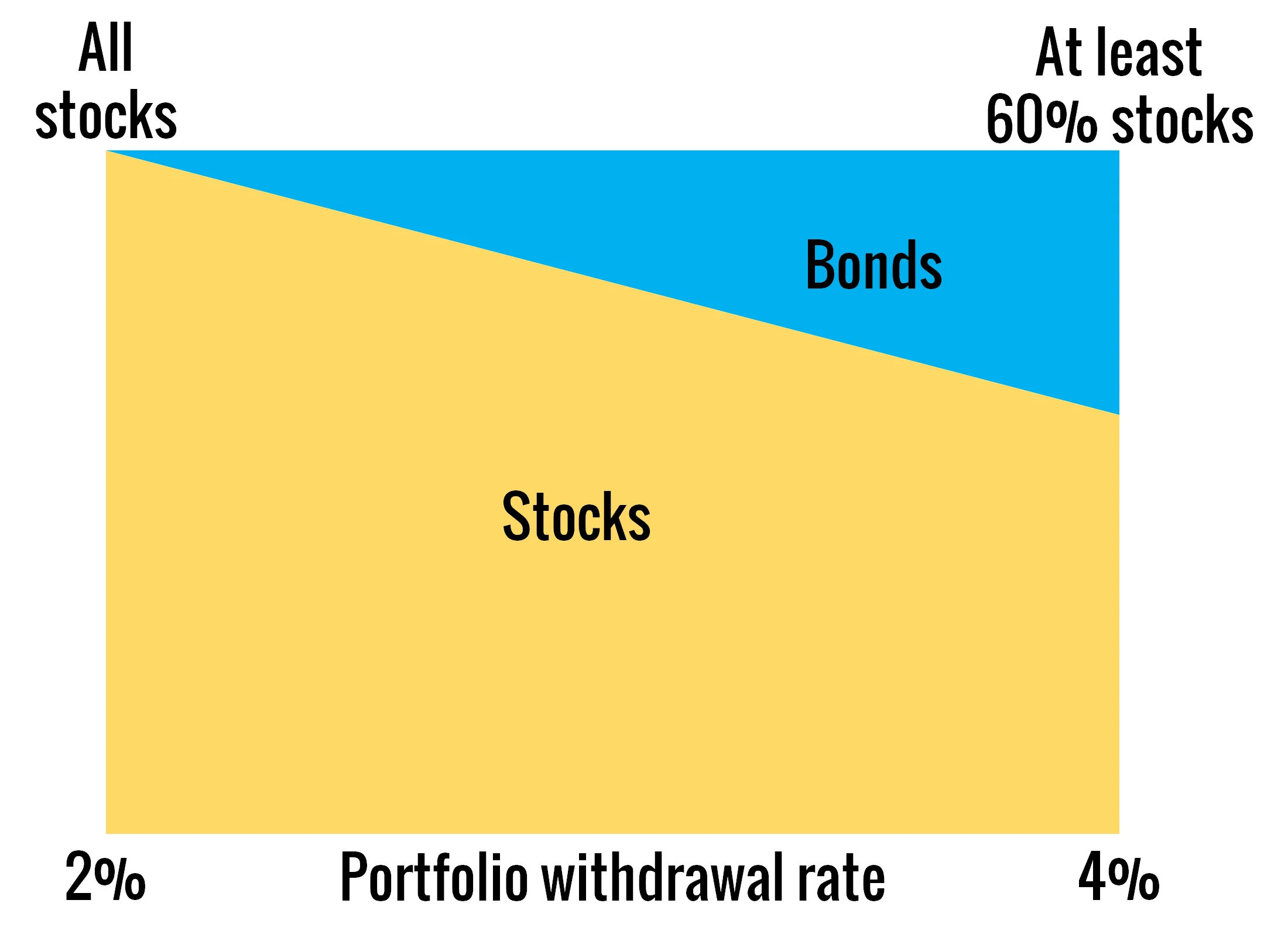
But this assumes your portfolio is structured the right way. Because the first 2% of the 4% you need can be met with dividends from stocks. But if you own an all stock portfolio, the remaining 2% must come from selling stocks.
And as explained before, you don’t want to be selling too much of your stocks in a declining market or else you won’t have much stocks left when they eventually recover. And markets will decline from time to time, oftentimes violently. Hence you mix in bonds that cover a good chunk of the income you need beyond what stocks generate as dividends.
Income from bonds barely keeps pace with inflation so in the end, you’d have less money than had you stuck with an all-stock portfolio. But being the richest person in the graveyard is not always the goal. Money is a tool to experience life true to your liking and that it will be there with near certainty when you need it.
So if you need to generate 50,000 dollars a year in income from a 2.5 million dollar portfolio, you don’t need to own any bonds as the 2 percent withdrawal rate ($50,000 is 2 percent of 2.5 million dollars) can be safely met with dividends from stocks.
Plus, dividends grow over time. In fact, the growth of dividends is designed to exceed that of inflation3.
But an all-stocks portfolio is going to be far more volatile than a balanced mix of stocks and bonds but that only matters if you make it matter.
Risk and return are inextricably intertwined. In almost every country where economists have studied securities returns, stocks have had higher returns than bonds. Further, if you want those high stock returns, you are going to have to pay for them by bearing risk; this is a polite way of saying that in the course of earning those higher returns, your portfolio is going to lose a truckload of money from time to time. Conversely, if you desire perfect safety, then resign yourself to low returns. It really cannot be any other way.
William Bernstein
And what about real estate? First, you likely have plenty of exposure to it if you own a home.
Plus, by being owners of businesses that make up the stock market, you already have a sizable implicit exposure to real estate through real estate investment trusts and through direct ownership of physical real estate that the businesses behind the stocks own. Take McDonald’s for example. A fifth of its market value is derived from the physical ownership of real estate which it then leases to its franchises. Think the Apple spaceship campus, the Disney theme parks and on and on.
Also, the rent or the mortgage you pay is an indirect cost to the businesses you own through the stock market. The company has to pay you enough in your paychecks to enable you to live wherever the company decides to create that next job and still clear profits.
If it cannot, it will not be creating that job which then reduces demand for real estate which then eventually dents their prices.
So back to generating income from your savings, if all you need is a 2% withdrawal rate, you can choose to own an all-stock portfolio and depart this planet with generational wealth.
But if you need more income, then you’ll need to own bonds. This guideline below is a good starting point which you can then tweak based on your own unique circumstances.
Thank you for your time.
Cover image credit – Tima Miroshnichenko
- Stephen Rodrick. “The Trouble With Johnny Depp“, MarketWatch. June 21, 2018. ↩︎
- Eriq Gardner. “Johnny Depp Settles Blockbuster Lawsuit Against Business Managers“, The Hollywood Reporter. July 16, 2018. ↩︎
- Mark Hulbert. “You need to pay more attention to dividends — this math shows why they beat inflation“, MarketWatch. April 23, 2022. ↩︎